

You're on the list! We'll reach out when early access becomes available.
Oops! Something went wrong while submitting the form.
×
Metano is live on the Okta Integration Network. Tie every AI agent to its Okta identity, see what it does at runtime, and stop the agent and its access in one step.
Published on Sept 22 2026
# Metano Integrates with Okta to Bring Runtime Security to AI Agents
Metano is now part of the Okta Integration Network.
For most enterprises, identity starts and ends with Okta. Okta knows who a person is, which applications they may use and when their access should end, and it enforces that across thousands of applications with a consistency the rest of the security stack builds on.
AI agents put that identity to work in a way no application did before.
Consider a developer, signed in through Okta, who starts a coding agent to close a ticket. The agent reads the ticket, calls a GitHub MCP server that connects to the repository, runs a Jenkins pipeline and pushes a fix. Four hops use the same human identity for all of them, and at each hop the agent decides what to do next. Attackers insert hidden instructions to compromise the agent and get the developer's access, and use the MCP server to carry them out, and the tool to run them with whatever elevation the developer's terminal had. Every login in that chain was legitimate, and Okta finds it legitimate. Metano looks at the context and intent to allow or block it.
That is the approved path. Beside it sits a quieter risk. An organization that has sanctioned Claude Code and Codex still has copies on laptops that were never signed in to anything, next to tools nobody sanctioned at all. Unauthenticated agents and shadow AI are latent risk of the same kind, and neither shows up in an identity system on its own.
Okta answers the first question with authority: who is this, and what may they access. Metano answers the second: what is this agent doing with that access, right now, and is it what the person intended. At runtime, Metano knows which human identity is behind the agent, which identity each MCP server is acting under, and what context and elevation every tool call carries. Together, for an Okta customer:
- Every AI agent Metano finds across endpoints, browsers and infrastructure is tied to the Okta identity behind it, and the ones with no identity at all stand out.
- When an agent misbehaves, the responder sees what it could reach and can use a kill switch to stop it. Metano stops the running agent or MCP process, while the Okta integration revokes the associated access.
- Every record carries the identity, so audit, compliance and incident response work from one source of truth.
Okta owns the agent's identity and its access. Metano owns what the agent does with that access.
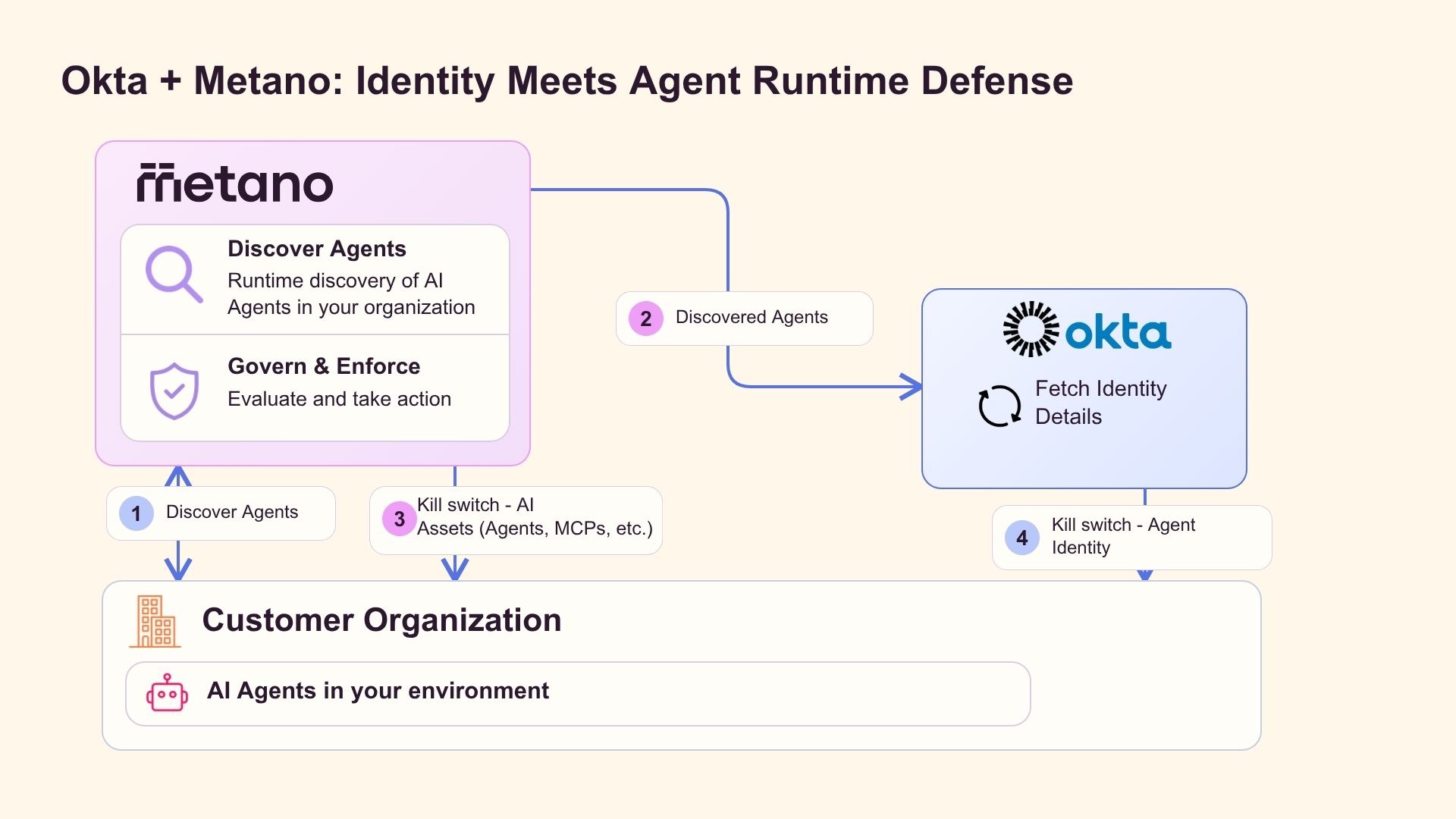
Metano is available today on the Okta Integration Network, with Okta single sign-on, SCIM provisioning and Universal Logout supported out of the box. The setup guide is at docs.metano.ai/integrations/okta. To see it running against your own Okta tenant, request a demo with the Metano team.
Explore the integration: www.okta.com/integrations/metano